



From Games to Generative AI: What We Took Home from ALPSP 2025
The ALPSP 2025 Annual Conference ran from Wednesday to Friday last week (10-12 September). After a busy few days catching up back in the office, we’ve had time to pause, reflect and draw out some of the key themes.
What struck us most was that innovation in publishing isn’t just about adopting the latest tools – it’s about solving real problems for researchers, editors and communities. Across the sessions, five themes stood out: user-centred design, authentic community engagement, pragmatic use of AI, new approaches to peer review, and smarter digital communications.
Here’s our recap of the highlights:
Session 1: Innovation Lessons from a Viral Tabletop Game
Speaker: Max Hui Bai (Director, Political Belief Lab)
Who would have thought a tabletop game could hold lessons for academic publishing? Max Hui Bai’s talk based on his ‘Publish or Perish’ game highlighted six principles of innovation that publishers can learn from:
- Understand users deeply – what do they need, and what frustrates them?
- Contrarian thinking – challenge conventional wisdom to uncover new opportunities.
- Edge-case thinking – solutions for a niche often benefit the many (think wheelchair ramps → also helping people with pushchairs, deliveries and travel).
- Design for emotion – people remember how an experience felt, not just whether it worked.
- Rapid feedback loops – observe real users in action and adapt quickly.
- Business model innovation – sometimes the biggest change is in how we fund and deliver knowledge.
Takeaway: Academic publishing needs to experiment more boldly, and not just with tech – business models and emotional experience matter too.

Session 2: Bridging the Gap – Community Involvement in Publishing
Speakers: Godwyns Onwuchekwa (Global Tapestry Consulting), Funmilayo Doherty (Yaba College of Technology), Kaitlin Thaney (Invest in Open Infrastructure), Guilherme Werneck (Brazilian Ministry of Health)
The panel stressed that audiences aren’t just consumers – they’re partners. True engagement means:
- Meeting communities where they are (including outside traditional publishing spaces).
- Acknowledging and addressing power imbalances.
- Showing action and responsiveness, not just listening.
- Starting small, proving impact and scaling gradually.
Takeaway: Engagement is meaningful when it’s built on trust, which must be earned through truly reciprocal partnerships.
Session 3: Awards Finalists Lightning Presentations
Moderator: David Sommer (Kudos)
Some of the most exciting projects spotlighted included:
- Atom Grants – an AI-powered search engine for identifying suitable funding grants.
- Frontiers for Young Minds – authors (including Nobel laureates) rewriting their research for 8-15 year-olds, peer-reviewed by kids.
- AI Talks with Bone & Joint – AI-generated podcasts to engage busy surgeons.
- Alchemist Review (Hum/Grounded AI) – rapid extraction and summarisation of manuscripts’ key insights (including citation and reference evaluation) to streamline editorial workflows.
- Taylor & Francis/DataSeer – AI tools to improve data transparency and reproducibility, checking manuscripts for compliance and informing future policy.
Takeaway: AI is already embedded in workflows – but the best examples are those which keep humans in the loop.
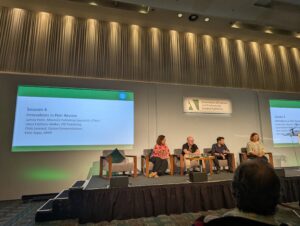
Session 4: Innovations in Peer Review
Speakers: Lynsey Haire (Maverick Publishing Specialists), Laura Feetham-Walker (IOP Publishing), Christopher Leonard (Cactus Communications), Enric Sayas (MDPI)
Peer review is under pressure from rising submissions coupled with reviewer scarcity/fatigue. Innovations discussed included:
- AI in review (MDPI) – tools such as Finder and Ethicality are useful for finding reviewers, spotting ethical issues and quality checks – but require human oversight.
- Professionalising peer review (Cactus Communications) – could/should we treat it as a recognised profession?
- Co-review models (IOP Publishing) – involving early-career researchers under supervision to diversify and expand reviewer pools.
Takeaway: Peer review is evolving into a hybrid ecosystem – AI accelerates, but human judgement and trust remain essential.
Session 5a: Digital Engagement and Social Media
Speakers: Kelly Henwood (TBI Communications), Jitske de Vries (The Company of Biologists), Tina Harseim (Springer Nature), Charlie Rapple (Kudos).
Key lessons on social media strategy:
- Long-form content can work on social, if supported by bite-sized fragments linking back to it.
- Paid social drives reach and amplifies organic growth.
- LinkedIn remains important – with staff acting as brand ambassadors outperforming corporate accounts.
- Newer platforms like Bluesky offer engagement opportunities, while X (Twitter) still drives traffic.
Takeaway: Fragment and reframe content for different audiences and use staff networks as amplifiers.
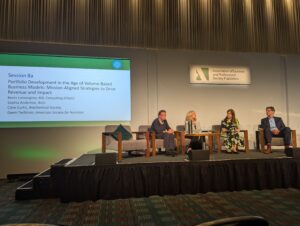
Session 8a: Portfolio Development in the Age of Volume
Speakers: Kevin Lomangino (KGL Consulting), Sophia Anderton (BJUI), Clare Curtis (Biochemical Society), Gwen Twillman (American Society for Nutrition)
Case studies showed how societies and associations are adapting:
- BJUI’s partnerships with 35 associations and the development of 450 self-directed learning modules drive users to the journals to extend reach without a member base of its own.
- ASN outsourced its publishing operations and has invested in a strategic planning initiative which will result in a more coordinated approach across the portfolio.
- Biochemical Society pivoted away from its young OA journal, instead expanding existing journals’ scope.
Takeaway: Portfolio management is about mission alignment, not just adding titles. Smarter, not necessarily bigger.

Final Thoughts
After a week back in the office catching up on day-to-day work, it’s been valuable to pause and reflect on what ALPSP 2025 offered. The sessions highlighted that innovation isn’t just about new tech (AI!). It’s about rethinking models, respecting communities, and designing for people first.
As we return to business as usual, these lessons remind us to continue shaping our work: being bolder in experimentation, more intentional in community engagement, and mindful in how we balance technology with trust.