Sep 15, 2026 | Events, Scholarly publishing
The ALPSP 2026 conference was full of ideas for changing scholarly publishing. For smaller societies, the harder question was how to create enough capacity to act on them.
The conference brought three days of discussion about an industry facing change on almost every front. AI was reshaping discovery, research practice and editorial workflows. Research integrity threats were becoming more sophisticated. Reviewer recruitment was getting harder. Global author and reviewer communities were changing. Metadata and machine readability were moving from technical concerns to strategic ones. Universities were under financial pressure. And throughout the programme, speakers offered tools, partnerships, new workflows and new ways of thinking that might help.
But beneath many of those conversations sat a more basic constraint.
Do publishers actually have the capacity to make the changes they already know they need to make?
For smaller societies in particular, that may be one of the most important questions facing scholarly publishing.
More work is entering the system
The pressure is not imaginary.
In the Industry Updates session, David Nygren of Silverchair presented data from ScholarOne showing submissions in 2026 running 33% above the equivalent point in 2025, after 16% growth across 2025 itself (though there are sensible questions to be asked about how 1 unit of submission is being defined here). The same presentation reported 2.5 desk rejections for every accepted manuscript, a 47% increase since 2022, while it now takes roughly twice as many invitations to secure a reviewer as it did eight years ago. Despite sustained efforts to make publication faster, time to acceptance and publication had risen 21% over the same period. This is not just straightforward growth – acceptances are not growing at the same rate – it is operational drag.
At the same time, entirely new categories of work are arriving.
The Zero Click session explored what publishers may need to do as researchers increasingly discover and consume scholarship through AI interfaces rather than publisher platforms: richer metadata, machine-readable content, better attribution, new usage measures and changes to the way content itself is structured. Better definition of lay person summaries was discussed as a potentially valuable addition to metadata quality. Where did the panellists think this task should live within the publishing workflow? I’ll give you three guesses, but you won’t need two of them.
Research integrity is creating another expanding workload. Liz Allen described a fragmented ecosystem in which smaller organisations may lack dedicated integrity staff or even an obvious person with the time and expertise to take ownership of emerging issues.
None of these problems can simply be ignored. But every response competes for the same finite resource: experienced people.
The capacity catch-22
That became particularly clear in Lean Editorial: Doing More with Less Across Peer Review and Editorial Operations, a session proposed by The Editorial Hub and chaired by our Office & Business Development Manager, Kate Pearson.
The panel brought together Kimberly Bayley-Tweed of the Biochemical Society/Portland Press, Katherine Brown of The Company of Biologists and Dustin Smith of Hum. The aim was deliberately to focus on the operational reality of smaller society publishers, whose experience can look very different from that of organisations running hundreds or thousands of journals.
The session was intended to explore how lean teams could use systems, partners, skills and emerging technologies more effectively, but what emerged was something more uncomfortable: the organisations with the greatest need to redesign their workflows are often the organisations with the least spare capacity to do so.
A workflow review sounds sensible. So does evaluating a new integrity tool, improving reviewer selection, redesigning triage, introducing automation or developing better reporting. But none of those things happens by magic.
Someone has to understand the problem, map the current process, gather requirements, research the market, send emails, book meetings, sit through demonstrations, compare suppliers, build a business case, negotiate, pilot, test, calibrate, write playbooks, train colleagues, establish governance, manage exceptions and monitor whether the change actually worked.
The work that could create future capacity consumes capacity today.
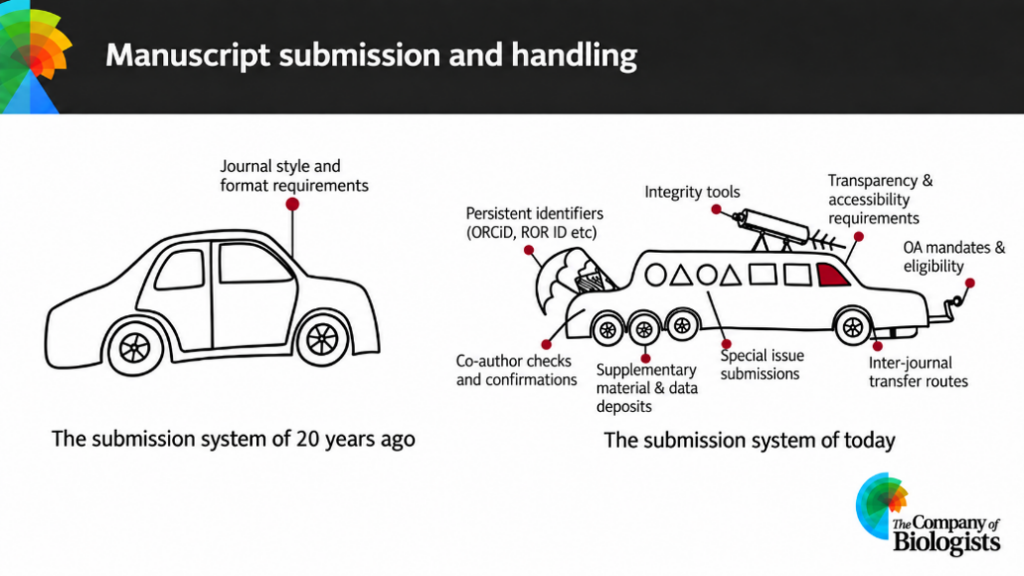
That tension came through vividly in the session. Katherine Brown captured the problem with a deceptively simple image: the submission system of 20 years ago as a basic car, and today’s system as an increasingly elaborate vehicle carrying identifiers, integrity checks, data requirements, accessibility, OA rules, transfers and more. None of those additions is necessarily unreasonable in isolation. Together, they show how easily a workflow can become something nobody would ever have designed from scratch.
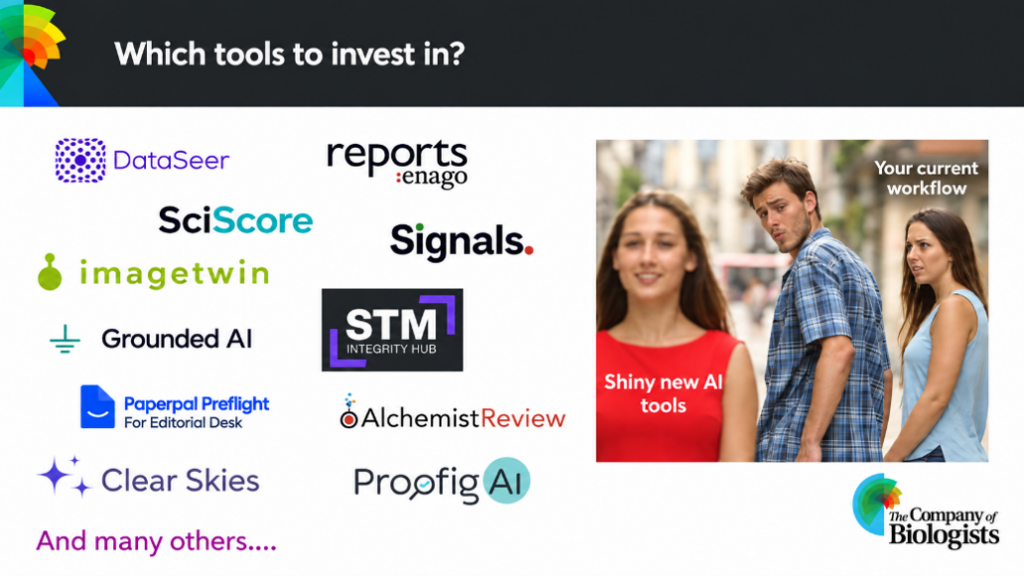
Another slide borrowed the familiar distracted-boyfriend meme to show organisations simultaneously committed to their existing workflow and continually tempted by the next shiny new tool. The difficulty is no longer simply finding a tool. As Katherine Brown’s slide made clear, publishers are now confronted by an expanding market of integrity, workflow and AI products, all competing for attention while the existing operation still has to run.
Choosing well means understanding not only what a product can do, but what problem it should solve, where it belongs in the workflow, who should operate it, what it costs to implement and govern, and what work it genuinely removes rather than relocates.
The number of people audibly laughing and taking pictures of these slides spoke to how recognisable and relatable an experience this was for the gathered audience. Conversations afterwards made clear that the problem extended well beyond the organisations on stage.
Don’t just build faster horses
Another conference session offered a useful way to think about the answer.
In Beyond Publishing: Lessons From the Outside, Jennifer Schivas of 67 Bricks returned to the familiar “faster horses” innovation problem. The point of the story is not that customers are incapable of knowing what they need. It is that if you ask only how to improve the existing solution you get incremental improvement, not disruptive innovation.
It is a useful reminder for editorial technology, where the conversation can quickly become tool-led.
The obvious question is: Which tool should we get?
But perhaps the better place to start is: Why are we doing this work at all? Why does it happen at this point? Why does this person do it? Which part requires expertise, and which part simply exists because the workflow evolved that way?
Amy Jones of Emerald made a related point using IKEA’s deployment of AI for routine customer queries. The interesting bit was not simply the automation – IKEA used the capacity it released to retrain people into higher-value work.
The useful lesson is not that every routine task should be automated. It is that any time saved needs somewhere better to go.
For smaller publishers, however, even asking those questions properly requires time.
And the tools market does not make matters easier. Conversations throughout the conference reinforced that many publishers know they need to modernise but feel overwhelmed by the scale of the market and the effort required to distinguish genuinely useful products from superficially similar propositions.
A tool is not a strategy. Nor is it a silver bullet. A very good product can still deliver very little if it is badly placed in the workflow, poorly calibrated, weakly governed or inadequately supported.
Protect human judgement
ALPSP also offered a clearer picture of where technology may create the most useful capacity.
Natalie Khalil of Reviewer3 described peer review as containing both objective verification and subjective scientific judgement. In benchmarking more than 145,000 review comments, her team found that humans concentrated more heavily on areas such as contribution and clarity, while automation could support technical checks and pre-review triage. That is a more useful way to approach this complex issue than trying to treat peer review as one single process that can either be automated or not.
The research integrity session told a similar story as Kim Eggleton described IOP Publishing’s use of the STM Integrity Hub duplicate-submission checker as a simple intervention that can remove significant manual effort. Hylke Koers explained how the Hub now brings together more than 50 publishers, collectively scanning over 300,000 submitted manuscripts each month and sharing intelligence that no individual publisher could realistically reproduce alone.
But integrity is also a moving target. IOP’s work on detecting identical reviewer reports is a useful reminder that today’s signal may not remain tomorrow’s signal. If obvious template-style similarities become less common, is that because manipulation has reduced, or because generative AI makes unique, plausible-looking reports easier to produce?
That is a question, not a conclusion. But it illustrates why research integrity cannot be “implemented” once and considered finished. Detection, policy and workflows all have to evolve.
Creating capacity to change
There is another capacity issue that deserves more attention: small publishing teams are often exceptionally committed. That commitment can conceal a structural problem if essential work is sustained partly through discretionary effort, extra attention and goodwill.
How resilient is a workflow if it only works because people continually stretch to absorb one more integrity check, one more reporting requirement, one more tool, one more author expectation? That is not simply a wellbeing question, it is an operational-risk question.
For societies facing this reality, the useful question may not be “should we outsource?” or “which technology should we buy?” but “what kind of capacity are we actually missing?”
From our work with societies and small press editorial teams, that capacity gap tends to show up in two ways. The first is the capacity to design the future operation: to understand the workflow, define requirements, assess the tools market, compare options, pilot changes, document decisions and put governance around whatever is introduced.
The second is the capacity to keep the current operation running while that work happens. Sometimes that means targeted support with editorial office work, desk editing, reviewer selection or integrity checks, so internal teams have enough room to step back from business as usual and make change properly.
Because The Editorial Hub is technology-agnostic, the starting point does not need to be a particular platform or product. It can be the problem itself.
By the final conference wrap-up session, our Lean Editorial session had been highlighted as one of the sessions that best captured the need to balance efficiency with human oversight. Tasha Mellins-Cohen also challenged the industry to look again at entrenched workflows and the amount of work continually pushed onto authors and reviewers – that feels like the right challenge to take away from ALPSP 2026.
As an industry, journals publishing is not short of ideas for change.
The harder question is whether we are creating enough room to implement them well.
Jul 27, 2026 | Events, Scholarly publishing
Lean editorial is not about doing the same work with fewer people
Every new expectation in scholarly publishing lands somewhere in an editorial workflow.
A manuscript arrives, but it no longer needs only careful handling, reviewer invitations and a clear decision. It may also trigger metadata validation, research integrity screening, open-science questions, author identity verification, funder-compliance checks, data-policy requirements, reviewer-availability challenges and the everyday work of keeping authors, editors and reviewers properly informed.
None of these expectations is unreasonable. Most reflect priorities that authors, readers and journal communities genuinely value: trust, transparency, rigour, speed, fairness and a better experience for the people who give their time to scholarly communication. But each expectation creates operational work. It needs to be sequenced, owned, recorded, checked, escalated or explained.
That is why “lean editorial” is such an important phrase to handle carefully.
Used badly, it can become a euphemism for asking stretched teams to absorb more work with fewer people. Used well, it means something much more useful: designing editorial operations so that scarce human attention, existing systems, specialist partners and new tools are used where they genuinely add value.
The case for leaner editorial redesign is becoming hard to ignore. Hanson et al.’s 2024 paper, “The strain on scientific publishing,” argues that article output has grown far faster than the human capacity required to write, review and edit it. That pressure is not abstract. It shows up in delayed decisions, overdue editor tasks, declining reviewers, increased manuscript status enquiries, and increasing reliance on workarounds that were never designed to become permanent infrastructure.
Reviewer pressure makes the point particularly clearly. Routledge and Pariente, writing in PLOS Biology in 2025, describe a system in which invitations increasingly outweigh researcher capacity to complete reviews. Recent journal-level data from Morley et al. in PRiMER gives that pressure a tangible form: in one journal, reviewer invitation acceptance peaked at just over 56% in 2020, then fell to around 36% in 2024, with completion rates also declining. Inviting ten reviewers where three might once have been enough may be necessary in the short term. It is not, on its own, a strategy.
A leaner approach asks a different set of questions. Which manuscripts should reach external peer review at all? Which checks should happen earlier, before reviewer time is spent? Where can stronger pre-review editorial assessment, clearer scope control or refreshed reviewer records reduce avoidable chasing and repeated invitation rounds? Where are editors being asked to solve operational problems that could be handled through better workflow design or additional support?
Open science and transparency expectations add another layer. Howard et al.’s account of open science at Clinical Psychological Science is useful because it shows that transparency is not simply a policy preference; it can require new roles, checks and processes. Funder and open-access compliance create similar operational demands. Tools such as Jisc’s Open Policy Finder exist because policy requirements are complex enough to need structured navigation, while Jisc’s UKRI guidance reminds publishers that compliant routes should be easier for authors to understand and use. Reducing friction is not a soft service aim; it is part of making policy workable.
Research integrity has followed a similar path. Paper mills, systematic manipulation, duplicate submissions, image concerns and inappropriate AI use are no longer occasional exceptions that can be handled entirely outside the workflow. STM Integrity Hub and United2Act both show how much work is now going into practical tools, guidance and implementation support for integrity challenges that affect the whole sector.
AI-enabled workflow and integrity tools are also now part of editorial reality, not a future possibility. The practical question is how they are governed, where they add value, and where human judgement must remain explicit. The 2026 SSP Pulse Check suggests a community experimenting with AI while worrying, rightly, about ethics, privacy, quality and capacity. UKRIO’s 2025 guidance similarly frames AI as an integrity issue touching legal compliance, ethics, the research record, dissemination and critical thinking. In editorial terms, tools can help teams see more, sooner: patterns, missing information, possible manipulation, workflow risk. But outputs still have to be interpreted. Poorly placed automation creates friction. Well-governed automation creates capacity.
This is where society publishers and smaller teams have an important perspective to offer. Research Consulting’s 2025 white paper on the future of society publishing found that most societies still see publishing as central to their mission, even while many face declining revenues and pressure to adapt. Smaller publishers may lack the scale of larger commercial houses, but they are often closer to their communities, more alert to disciplinary context and more conscious of the trust they hold.
That is the thinking behind Lean Editorial: Doing More with Less Across Peer Review and Editorial Operations, taking place at the ALPSP Conference 2026 on Thursday 10 September, 11:20–12:05, in Deansgate Suite 3. Chaired by Kate Pearson of The Editorial Hub, a Silver Sponsor of ALPSP Conference 2026, the panel brings together Kimberly Bayley-Tweed, Publishing Operations Manager at Biochemical Society / Portland Press; Katherine Brown, Publishing Director at The Company of Biologists; and Dustin Smith, Co-founder and CEO of Hum to explore these questions in practical terms.
The discussion will stay close to the practical realities of editorial work: how teams evolve workflows, build capability, use vendors and tools selectively, manage integrity and open-science expectations, and decide where human judgement is essential.
That is the real promise of lean editorial: not doing everything faster, nor asking teams to stretch indefinitely, but making better operational choices so that journals can maintain rigour, protect author and reviewer experience, and remain realistic about the resources available.
Join us at Parallel Session 6b, Lean Editorial: Doing More with Less Across Peer Review and Editorial Operations on Thursday 10 September, 11:20–12:05, Deansgate Suite 3.
This is a repost of an article written by The Editorial Hub and published on the ALPSP blog on 20th July 2026.
Apr 29, 2026 | Company information and news, Events, Scholarly publishing
We’re delighted to share that The Editorial Hub is a Silver Sponsor of the ALPSP Annual Conference and Awards 2026, taking place from 9-11 September in Manchester.

The ALPSP Annual Conference is a cornerstone event for scholarly and professional publishing, bringing together publishers, societies, service providers and industry partners from across the global community. As long‑standing supporters of collaboration, integrity and innovation in editorial workflows, becoming a Silver Sponsor felt like a natural step for us.
ALPSP plays an important role in strengthening and advocating for not‑for‑profit scholarly publishing, while bringing together a broad international community of society, university and commercial publishers, alongside the service providers that support them. With more than 320 member organisations across 35 countries, the conference offers a rare opportunity to step back from day‑to‑day operations and engage in meaningful conversations about what publishing needs next – whether that’s navigating technological change, improving peer review health, or responding to evolving community expectations.
At The Editorial Hub, we work closely with journals and publishers to support robust, scalable editorial and peer review processes. Our presence at ALPSP reflects our commitment not just to the tools and systems that underpin publishing, but to the people, partnerships and shared standards that make the ecosystem work.
As Silver Sponsor, we’re pleased to be supporting an event that values thoughtful discussion, practical insight and collective progress across the industry. We’re particularly looking forward to the conversations that emerge when publishers, societies and service providers come together to reflect honestly on shared challenges – and to explore what genuinely sustainable solutions look like.
If you’re attending the conference in Manchester this September, we’d love to see you there and connect in person. Whether you’re thinking about editorial workflow efficiency, peer review resilience or future‑proofing journal operations, we always welcome the chance to exchange ideas and learn from others in the community. And if you’d like to start a conversation ahead of the conference, you’re very welcome to get in touch at any time – we’re always happy to talk through editorial challenges, share perspectives, or simply compare notes on what’s changing across the scholarly publishing landscape.
We’re delighted to continue supporting ALPSP and to be an active part of what promises to be an engaging and thought‑provoking conference.
Mar 1, 2026 | Events, Scholarly publishing
Researcher to Reader Conference Report (24–25 February 2026)
Practical notes for peer review operations and research integrity workflows
Researcher to Reader is built for participation. Speaker introductions are minimal, workshops are central, and breaks offer a choice between networking and optional lightning talks. For editorial office and peer review operations professionals this was an ideal program. Rooted in workflow reality, its talks, panels and workshops covered trust signals and triage, reviewer availability, tools, and author communications – all top of mind for those working in this space.
Day 1 – Tuesday 24 February 2026
Keynote: Open and Secure Research (Dr Leslie McIntosh, Digital Science)
Leslie McIntosh’s keynote separated “open” from “trusted”, positioning research integrity, research security, and public trust as interlinked rather than separate agendas. Her framing drew on her FoSci work and the idea of a “battle for knowledge”, where power is exercised through the narratives and legitimacy created by the scholarly record.
A strong operational thread for journal teams was the cognitive reality of the current environment: decision fatigue and signal overload are not incidental; they shape what editors, reviewers, and readers can realistically evaluate. McIntosh used “smart” technology as an analogy for how overcomplication consumes attention and pushes systems toward what is easiest to measure rather than what is most consequential.
For editorial offices, the keynote translated into a practical question: what “trust markers” are being captured, validated, and surfaced consistently? The implied challenge was not simply to collect more verifiable data points, but to build workflows that make correction possible at scale.
Workshop B: Using Incentives to Improve Peer Review (Dr Alejandra Clark, The Company of Biologists; Dr David Maslove, Queens University; Dr Tommaso Valletti, Imperial College London)
Workshop B ran as a mini-sprint across the conference: three working meetings (discussion plus small-group design work) ending with a day 2 plenary playback.
The first meeting stress-tested the usual assumptions behind reviewer scarcity: are researchers declining more often or are journals still drawing too narrowly from familiar networks; would widening pools in line with where research is being produced help; and how do editors build confidence in reviewers outside their personal circles when trust feels strained. The discussion kept returning to the same mismatch: heavy reliance on unpaid labour with limited recognition. Paid peer review was debated, with noticeably fewer blanket objections than in similar pre-COVID conversations. Some participants reported their practical experience of paying peer reviewers with positive outcomes.
The second meeting, led by economist Dr Tommaso Valletti, added a blunt warning: incentives can “solve one problem and create another.” Groups interrogated ideas like who pays/benefits in a paid peer review system, who can game it, is it reversible, and what trade-offs are being made between speed, quality, and fairness.
By the third meeting, two proposals were refined for plenary playback: a reciprocity commitment model (authors commit to reviewing within a defined period if their paper is sent for review) and a monetary “marketplace” model (a cross-publisher platform where authenticated reviewers can bid to review manuscripts, with mechanisms to evaluate review quality).
Financial incentives for peer review have moved from taboo to plausible at speed. If paying reviewers is moving from theoretical to operational, then a consistent mechanism by which to assess delivered review quality becomes key.
Roundtable: Making Peer Review Better for Researchers (Jayne Marks, Maverick Publishing Consultants (moderator); Dr Ritu Dhand, Springer Nature; Dr Gareth Dyke, Prophy.ai; Dr Chris Leonard, Cactus; Dr Stewart Manley, Maynooth University)
This roundtable asked what authors and readers actually want from peer review, including how to make processes faster and more efficient, whether support should begin earlier in the research lifecycle, how to widen reviewer pools globally (including Asia), and what early career researchers need to trust the record.
Q&A sections around perceived blockers to progress became pointed, as researcher contributors argued that publishers can inhibit peer review innovation through conservative policy and workflow inertia, while others challenged how “quality” judgements can drift into uneven practice across journals and research areas. Accusations of poor editorship and bias surfaced, alongside the recurring gap between public expectations of peer review as a truth test and the reality of peer review as an iterative and variable improvement process.
For operations teams, the practical lesson is familiar but important as ever: opacity and inconsistency are interpreted as bias. Clear criteria, consistent application, and legible decision rationales reduce escalation heat, protect reputation, and maintain community trust.
Presentation: Facing AI Futures Together (Professor Keith Webster, Carnegie Mellon University Libraries)
Keith Webster framed AI, at root, as a forecasting tool. He set up two “critical uncertainties” that will shape what scholarly communication becomes next: societal intentionality (how far we regulate, critique training data, correct bias and govern AI, and whose values drive that governance) and societal adaptation (how deeply AI reshapes institutions and day-to-day research practice).
From these axes he mapped four futures. A values-driven, high-adoption world produces Democratised and socially integrated AI: open knowledge flows designed deliberately around shared values, with publishers acting as quality signals — and, he argued, the hardest outcome to realise. A values-driven, low-adoption world produces Consumer-oriented AI: AI behaves as an independent collaborator and human oversight gradually recedes. Ad hoc, market-driven, low-adoption leads to Laissez-faire AI: rapid uptake with weak governance, bias and fragmentation, and a polluted knowledge base. Ad hoc, market-driven, high-adoption produces Autonomous AI: AI becomes collaborator or leader, human oversight retreats further, and the scholarly record fragments, raising the uncomfortable publisher question of who the “reader” even is.
For editorial offices, these scenarios are a prompt to redesign for provenance, consistency, and post-publication accountability, because discovery and “reading” are shifting outside journal control while trust still depends on what the journal can evidence.
Debate: Artificial Intelligence Tools “AI Tools Will Provide a Net Benefit to Scholarly Communication” (Rick Anderson, Brigham Young University (moderator); Darrell Gunter, Gunter Media Group (for the motion); Amanda Licastro, Swarthmore College (against the motion))
The audience began optimistic (80% expecting AI to improve scholarly communication) and ended more sceptical (52% expecting it to make things worse), a swing driven largely by arguments about provenance, governance, bias, hidden labour and incentives, and the risks of trading long-term control for short-term convenience.
For peer review operations professionals, we are again reminded that “AI benefit” depends on governance, transparency, and the ability for humans to contest and correct outcomes when tools are wrong.
Day 2 – Wednesday 25 February 2026
Panel: Rethinking Peer Review (Dr Jonny Coates, Rippling Ideas (moderator)); Dr Katherine Brown, The Company of Biologists; Thomas Guillemaud, Peer Community In; Dr Peter Rodgers, eLife)
The panel discussed journal-independent, community-led peer review models linked to preprints (including approaches such as eLife, EMBO, Review Commons and Peer Community In), aimed at earlier dissemination of work, reduction of review waste and enabling reviews to travel with a manuscript.
Audience discussion stressed that slow adoption is driven less by publisher resistance and more by author ambivalence: major publishers have funded trials, but take-up has rarely been sufficient to shift default behaviour. Panellists agreed this reflects the difficulty of reaching time-poor researchers – broadcast marketing has limited impact, while genuine engagement is slower and more costly, especially for smaller organisations. “Scooping” concerns were addressed as largely a misconception, since preprints establish priority via DOI; questions from the floor also showed that even basic preprint mechanics are not yet well understood by the research community.
Editorial office takeaway: portability is attractive, but it only works at scale if journals invest in clear author guidance and engagement that changes behaviour, not just promotion.
Case Study: Business Models – S2O: The Good, the Bad and the Ugly (Stacey Burke, APS (moderator), Dr Dennis Brown, APS; Professor Wolfgang Kuebler, Charité–Universitätsmedizin; Lou Peck, The International Bunch)
The American Physiological Society (APS) shared their experience with Subscribe to Open (S2O). Their early approach prioritised renewals, with an expectation that value would naturally extend to authors and readers. Feedback revealed confusion, prompting experiments with lighter feedback tools and revised messaging.
Slides and discussion emphasised clearer articulation of organisational purpose (highlighted by APS’s successful “Publish with Purpose” campaign), and the usefulness of the S2O Community of Practice for support and ideas.
For editorial offices, new business model messaging and unfamiliar eligibility rules often land as author queries, increased support load, and additional friction at submission and post-acceptance touchpoints. Get the messaging right and these capacity issues reduce.
Presentation: Publication Formats – Beyond the Journal Article (Christian Kaier, Graz University Library; Dr Lisa Schilhan, Graz University Library)
Kaier and Schilhan presented survey findings from 600+ researchers on publication formats beyond the traditional article: data publications, software and code, replication studies, repositories/databases, teaching materials/OER, and science-to-public outputs.
Slides translated the implications into stakeholder actions: libraries supporting infrastructure and cataloguing; funders recognising diverse outputs in assessment; publishers developing models, metadata schemes, and QA processes for novel outputs.
Presentations: AI in a Global Context – Does AI Promote Equity or Division? (Nikesh Gosalia, Cactus Communications)
Nikesh Gosalia opened with Kodak’s “Shirley card” story as a clear illustration of how bias becomes a default calibration. He used this to frame a risk for scholarly publishing: AI can lower barriers or scale exclusion, depending on what it is calibrated to “see”.
He anchored the point with an attention-grabbing statistic: 93% of GPT-3’s training data was in English, alongside the observation that tech giants now publish fewer comparable breakdowns. His argument was less about a single model and more about the consequences of opacity: if the sector cannot see what a system is trained on, it cannot predict how it will behave for different researcher communities.
His composite “Dr Amara” workflow illustrated how disadvantage can accumulate across routine steps: discovery gaps for non-English outputs, translation flattening, automated integrity checks that misinterpret English as a second language patterns, and reviewer mismatch leading to lower-visibility publication routes, reinforcing what gets counted as “global knowledge” in future systems.
Presentations: AI in a Global Context – Making AI Work for Global Research Integrity (Simone Ragavooloo, Frontiers)
Simone Ragavooloo presented findings from Frontiers’ global survey work and positioned the current challenge as a governance gap rather than a novelty gap. Frontiers’ white paper reports that 53% of peer reviewers already use AI tools, and frames the next phase as requiring trust, training, and governance to keep adoption from becoming unsafe or inequitable.
Two findings strengthened what many in the room were already experiencing operationally: high concern about misuse (71% concerned about misuse by researchers; 45% about misuse by publishers) and low visibility of when and how AI is used in publishing workflows.
Simone described Frontiers’ practical response: creating living guidance for researchers (a playbook-style set of guidelines intended to evolve over time) and piloting a closed-system review assistant to support peer reviewers while also allowing Frontiers to observe how the tool is used in practice and where additional guardrails or training are needed.
The Q&A session following these two talks brought three operational risks into focus: funding and capacity for robust non-English model development remains unresolved, despite early regional initiatives. Human bias persists and can become embedded in routine workflow choices, including patterns of “extra QC” requests clustered by geography or topic. “Human in the loop” can degrade over time: when tools appear consistently reliable, editors and staff check outputs less closely unless workflows deliberately enforce sampling, second-look triggers, and regular audits.
Final thoughts
For editorial offices, the recurring themes were:
- Pair integrity tools with clear, evidence-led author communication and an appeal route.
- Treat “human in the loop” as something you design carefully and audit regularly.
- Assume incentives and new output types will force workflow changes.
If these issues are top of mind, The Editorial Hub can be your partner, creating practical policies, templates, and QC routines to support your workflows.
Get in touch for a free, no obligation chat.
Dec 16, 2025 | Events, Scholarly publishing
STM’s Innovation & Integrity Days (9-10 Dec 2025) in London were framed as a multi-stakeholder conversation, but a lot of what was discussed lands directly on editorial offices: managing editors, journal coordinators, assistant editors and publisher-side integrity staff. This isn’t just about high-level policy, it’s about how submissions are screened, how editors are supported, and how conversations with authors and reviewers are going to change.
Here’s what the two days signal for people working on the ground.
- Integrity tools are becoming part of core workflow, not an optional add-on
The Innovator Fair made one thing very clear: the tools are converging on the editorial desk.
Systems like the STM Integrity Hub, DataSeer, Smart Publish, PubShield, Enago Reports, ReviewerZero and others are all pushing toward the same pattern: one embedded view of multiple integrity signals, rather than five different logins and exports. For editorial offices this means:
- More signals on each manuscript (images, text, references, data, identity, networks).
- Fewer standalone dashboards, more integration into systems like Editorial Manager, ScholarOne and the like.
- A shift from “should we run this check?” to “how do we interpret this combined report?”
On the desk, this changes the job from doing checks to triaging them. You’ll need:
- Clear SOPs for what to do with specific patterns of flags.
- Thresholds for when to escalate to research-integrity specialists.
- Templates for neutral, factual queries to authors about technical findings.
The technology is the start; the real work is designing consistent responses around it.
- Checks will move earlier and go deeper
Several sessions – on the Integrity Hub, image/data authenticity, and the sleuths’ work – pointed in the same direction: pre-publication is where the real defence has to happen.
For editorial teams this likely means:
- More pre-submission or pre-review screening (plagiarism, duplication, image anomalies, strange references, “AI nonsense” language).
- More frequent requests for original images and underlying data, not just prettier figures.
- Stronger expectations that journals know what they will and will not accept as “provenance”.
You should expect author guidance to tighten. Instructions for authors will need to be clearer about:
- What editors and offices will ask for in problematic cases
- How images and data should be stored so that provenance can be shown
- What happens if authors cannot or will not supply originals
For support staff, the practical impact is more back-and-forth before peer review even starts, with more technical documentation attached to each case.
- Identity checks are coming – and may help more than they hurt
The digital identity discussions were blunt: publishing runs millions of articles a year with almost no “know your customer” equivalent.
Static affiliation is no longer enough. Shell institutions, exaggerated affiliations and identity spoofing are all in play. At the same time, there are serious experts working outside traditional academia who struggle to enter editorial workflows because they lack a neat university label.
For editorial teams, the likely direction is:
- More structured identity verification at certain points (e.g. new corresponding authors, guest editors, reviewers from unknown institutions).
- More use of ORCID, institutional attestations and simple ID checks to reduce spoofing.
- Possible TSA pre-check style “lanes” where higher-assurance identities enjoy fewer manual checks.
There was also a useful reality check: in daily life, people already accept identity checks everywhere – banking, smartphones, even renting an e-scooter. Relative to that landscape, asking for basic ID assurance around work that influences patient care, public policy and now AI training data is hardly extreme.
Your role will likely include:
- Explaining calmly why extra checks are being introduced.
- Ensuring any new ID workflows are documented and applied consistently.
- Watching for equity issues – for example, how new requirements affect authors without strong institutional backing.
- Provenance isn’t abstract – it will change how you handle images, data and supplements
The “authenticity of images and data” sessions were clear: we are not going to win an arms race against future image and data fakery by detection alone. As AI-generated content improves, some manipulation will be practically undetectable.
Editorially, this shifts focus from “spot the fake” to “prove the workflow”. That means:
- Treating original images, lab metadata and data files as normal parts of the submission ecosystem, not rare exceptions.
- Taking supplementary materials more seriously: they are where many critical data now live, and where LLMs will mine heavily.
- Being ready to ask, “Where did this image/data come from? Can we see the unedited version? Do we have enough to be confident?”.
Several ideas that may reach the desk:
- Journals asking for signed or registered originals in higher-risk fields.
- Data-focused reviewers (perhaps postdocs?) involved alongside traditional peer review.
- Badges or indicators in articles where provenance checks have gone beyond the minimum.
For staff, this means more file handling, more liaison with production and more judgement calls about when “enough provenance” has been demonstrated.
- Working with institutions and sleuths will need structure, not ad hoc goodwill
Panels on publisher–institution collaboration and the “session with the sleuths” exposed real friction:
- Institutions see publishers as slow or opaque.
- Publishers see institutions as unresponsive or defensive.
- Sleuths see both as under-resourced and often silent after detailed reports.
For people inside editorial workflows, there are three practical implications:
- Case handling needs clearer channels
- Know who handles serious integrity cases in your organisation.
- Know how and when to contact institutions (and what not to send).
- Keep a clean audit trail: dates, decisions, communications.
- Sleuth reports need visible triage
- Acknowledge receipt promptly.
- Log reports in a trackable system.
- Close the loop where possible (even if the outcome is “no action, here’s why”).
- Backlog management will move from “nice to have” to expectation
- Tools that find articles citing retracted work are here.
- Editorial offices may be asked to support back-catalogue sweeps, not just new submissions.
- You’ll need criteria for what gets investigated first.
The message from sleuths was straight-up: if publishers want their help, they need to show that it leads somewhere.
- Policy frameworks are under strain – you will feel that at case level
Guideline bodies and cross-publisher initiatives are updating retraction guidance, expressions-of-concern policies and support for editors under pressure. At the same time, we are seeing on the ground that the volume and sophistication of fraud is testing procedures designed for a now bygone era.
On the ground, this shows up as:
- Long, complex casework in resource-hungry conditions.
- Risk/reward of following industry best practice called into question.
- Grey areas where existing policies say little (paper mill adverts, recycled images).
- Pressure from multiple directions: authors, institutions, sleuths, media, internal leadership.
The emerging direction may well be:
- Keep due process and fairness, but
- Develop faster tracks for situations with clear, well-documented evidence.
- Be explicit about which pathway a case is on, and why.
Editorial staff may not write the policies, but you will enforce them, document them and explain them repeatedly. Expect more attention to internal training on this.
- What skills and behaviours will matter most?
Across both days, a pattern emerged of what the system increasingly needs from editorial teams:
- Triage, not just task execution
Ability to interpret multi-signal reports and make sensible calls about escalation.
- Calm, precise communication
Neutral, factual language in difficult emails to authors, reviewers and institutions.
- Comfort with tools and data
Not coding, but understanding what image, text and data checks can and cannot tell you.
- Process literacy
Knowing your own policies, where they’re strong, and where they’re silent – and documenting decisions accordingly.
- Resilience and boundaries
Integrity work carries emotional load: accusations, counter-accusations, legal threats. You’ll need support and realistic workloads, not heroics.
The upside: the work is becoming more visible and more valued. The downside: it is also becoming more complex.
In summary
The STM Innovation & Integrity Days didn’t just showcase new tools or restate familiar principles. They described a future where research integrity is baked into every stage of the editorial workflow: who you accept manuscripts from, what you ask for, how you route signals, and how you interact with institutions, funders and sleuths.
For editorial professionals, this is not a bolt-on extra; it is the next evolution of the role. Calls from the stage for substantially increased investment in research integrity teams were met with clear, audible approval from a senior audience. That’s a signal: organisations know they need more capacity at the coal face. For anyone looking to deepen or reorient their career around integrity, there is likely to be more demand, more responsibility and, over time, more formal roles in this space.
Nov 24, 2025 | Events, Scholarly publishing
Our Research Integrity Manager, Jenny Bright, was an active member of COPE’s programme of discussions during Publication Integrity Week 2025. The week brought together global voices to explore the evolving challenges and opportunities in scholarly publishing, with each themed day highlighting the intersection of ethics, technology, inclusivity, collaboration, and innovation.
Jenny distilled the week’s discussions into several key insights:
- The evolving landscape of publication ethics. The week began with a reminder of ‘Why ethics matter in scholarly communications’. COPE’s early leaders discussed how challenges have grown since COPE was founded in 1997, but with a growing community of over 14,000 members, there is a building strength to ensure continuity of COPE’s mission. The discussion on ‘Commercialisation of research integrity’ highlighted how profit-driven misuse and policy gaps can undermine trust in the system. The session on ‘Technology for transparency’ promoted discussion on FAIR data and open research.
- Diversity, equity, inclusivity, and accessibility in practice (DEIA). Discussions focused on how integrity is inseparable from inclusivity. Case studies showed how journals are adopting policies to ensure equitable representation in authorship, peer review, and editorial boards. Integrity is not just about avoiding misconduct, it’s about proactively creating fairer systems.
- Collaboration and community building. Collaboration was a key theme throughout the week, and it was interesting to hear about both cross-institutional and cross-national initiatives. Panels explored how shared standards and joint investigations can strengthen integrity globally. The message was clear: no single journal or institution can tackle misconduct alone.
- Upholding publication integrity; the role of universities and research institutes. Sessions on institutional responsibility highlighted the need for trust and integrity, not just compliance during research. Institutions are developing frameworks and training for students, setting the tone for ethical publication of scientific research.
- Innovations, solutions, and the road ahead. The final day explored new publishing models and the tools available to editors and publishers to combat misconduct. It highlighted the evolution of AI as both a tool and a test for ethical frameworks and the need for clear cross-publisher policy.
The week was an insightful journey, from the roots of publication ethics, through present challenges, to future possibilities; giving a renewed conviction that integrity is a shared responsibility across the academic publishing community.